For various MSMEs in India, getting timely and affordable business finance remains a significant challenge. Many businesses struggle to arrange property or third party guarantees to get funding. This is where the CGTMSE loan without collateral becomes a game changer.
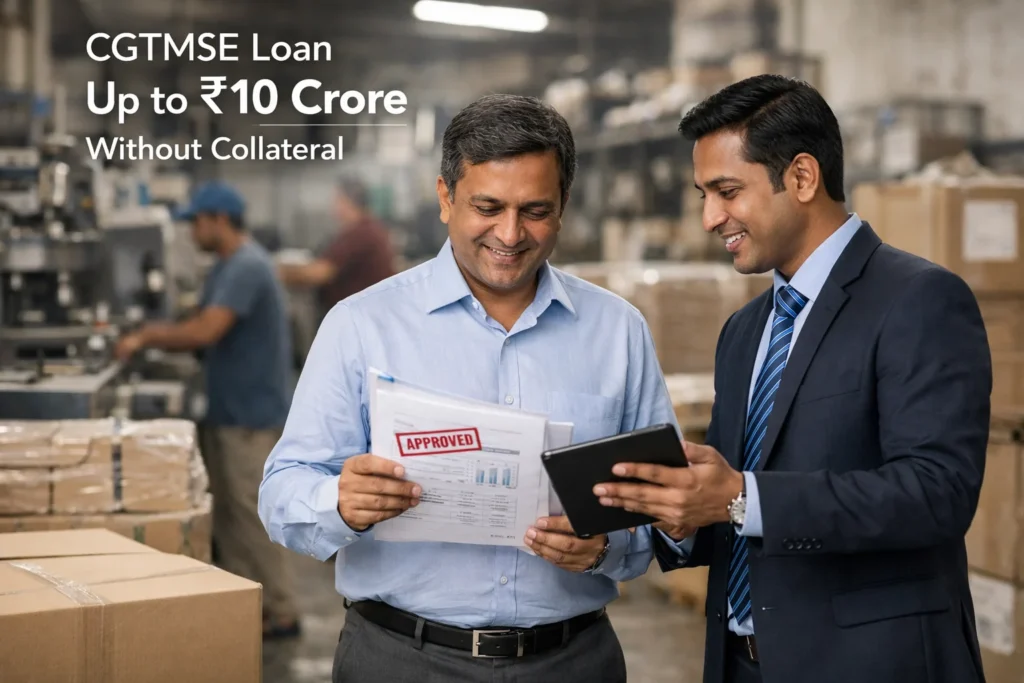
The Credit Guarantee Fund belief for Micro and Small Enterprises (CGTMSE) gives MSMEs to avail loans up to ₹10 crore without pledging collateral security.
The Credit Guarantee Fund for Micro and Small Enterprises (CGTMSE) is a government backed initiative launched by the Government of India, provide credit guarantees to lenders offering loans to MSMEs without collateral.
Under this scheme, banks and financial institutions provide loans to eligible MSMEs and CGTMSE offers guarantee coverage against default. This decrease the lender’s risk and encourages them to extend unsecured credit to small businesses.
CGTMSE loan without collateral allows entrepreneurs to secure business funding without mortgaging property or providing third party guarantees.
The primary objectives of the CGTMSE scheme are,
By offering credit guarantees to banks, the scheme ensures that viable businesses are not rejected funding simply due to lack of collateral.
One of the most attractive features of this scheme is the higher funding limit. Eligible businesses can avail loans up to ₹10 crore under the CGTMSE framework, depending on lender policies and business viability.
Understanding the CGTMSE scheme details related to loan limits helps businesses plan their expansion efficiently.
The maximum loan amount covered under the CGTMSE scheme can go up to ₹10 crore. However,
Businesses must also meet the CGTMSE loan eligibility turnover limit, which generally aligns with MSME classification norms under government guidelines.
CGTMSE loans can be sanctioned in two major forms
Both working capital and term loans are eligible for guarantee coverage under the scheme.
CGTMSE provides partial guarantee coverage to banks, typically ranging between 75% to 85% of the loan amount, depending on,
This means if a borrower defaults, the trust covers a significant portion of the outstanding amount, reducing lender risk.
However, CGTMSE coverage is not applicable in certain cases such as,
The scheme offers several advantages that make it one of the most preferred financing options for MSMEs.
The biggest benefit is that the CGTMSE loan without collateral removes the need for,
This makes it highly accessible for startups and first generation entrepreneurs.
Since the government backed trust provides guarantee coverage, banks face lower credit risk. This often leads to,
The scheme is particularly beneficial for new businesses that lack asset backing. Even first time entrepreneurs can apply, provided they meet CGTMSE scheme eligibility requirements.
This encourages innovation, manufacturing growth and servicensector expansion.
Repayment tenure generally varies depending on,
Term loans may extend up to 5-10 years, while working capital facilities are renewable annually.
Understanding CGTMSE scheme eligibility is important before applying.
This structured approach helps ensure smoother loan processing and better approval chances.
Applicants must fall under the official MSME classification based on,
The CGTMSE loan eligibility turnover limit typically aligns with government MSME definitions.
Both categories are eligible,
The loan approval depends on viability rather than years of operation.
While collateral is not required, lenders still evaluate,
A good credit profile significantly improves approval chances.
To process the loan, banks require standard CGTMSE loan documents, including,
Proper documentation ensures smooth processing and reduces delays.
| Feature | CGTMSE Loan | Regular Business Loan |
|---|---|---|
| Collateral | Not required | Usually required |
| Risk Coverage | Government backed guarantee | No external guarantee |
| Approval Criteria | Based on viability & eligibility | Based heavily on security |
| Accessibility | Startup friendly | Often asset based |
The CGTMSE loan interest rate is not fixed by the trust. It is determined by the lending bank based on,
In addition, borrowers must pay a guarantee fee and annual service fee as per scheme norms.
The CGTMSE Loan up to ₹10 crore without collateral is a impactful financial support system for MSMEs focusing to grow without pledging assets. By understanding the CGTMSE scheme details, eligibility criteria, guarantee coverage and required documents, businesses can make informed financing decisions.
If you meet the CGTMSE scheme eligibility and prepare the right documentation, this scheme can help you unlock growth capital with minimal risk and no collateral burden.
For MSMEs looking to expand operations, purchase machinery, manage working capital or scale operations, CGTMSE backed funding can be a strategic and practical financing solution.
To apply for a CGTMSE loan without collateral, you can approach a member lending bank directly or apply through a financial consultancy like KFIS Loan Agency, which assists in documentation and eligibility assessment. You must submit KYC documents, business registration proof, financial statements and a detailed project report. Once approved, the lender registers the loan under CGTMSE for guarantee coverage.
To secure a ₹10 crore loan without collateral under the CGTMSE scheme, your business must meet MSME eligibility norms and demonstrate strong repayment capacity. Preparing accurate financial records, income tax returns and a well structured business plan is essential. KFIS Loan Agency can guide MSMEs through the application process and help improve approval chances by ensuring complete documentation and compliance.
Under the CGTMSE scheme, eligible MSMEs can avail loans up to ₹10 crore without collateral, subject to lender evaluation and scheme guidelines. The final sanctioned amount depends on business turnover, financial strength, and project viability. Consulting loan experts like KFIS can help determine your eligible loan limit based on your profile.
Eligible borrowers include Micro and Small Enterprises engaged in manufacturing, services, logistics, trading (as per guidelines),and other approved sectors. Both new and existing MSMEs can apply, provided they meet turnover criteria and credit requirements. KFIS Loan Agency assists eligible businesses in verifying their qualification before submission.
The CGTMSE loan interest rate is decided by the lending bank or NBFC based on RBI norms, borrower risk profile and loan type. It is not directly fixed by the trust. In addition to interest, borrowers must pay a guarantee fee and annual service charges. KFIS helps MSMEs compare lender options to secure competitive interest rates and favorable repayment terms.
The information provided on this blog is for general informational and educational purposes only and is not intended as financial, investment, or legal advice. While we strive to ensure the accuracy and reliability of the information shared, we make no guarantees of completeness, accuracy, or timeliness. You should not rely solely on this information when making financial decisions. Always consult with a qualified financial advisor or professional before making any financial or investment decisions. The views expressed are personal opinions and do not represent any official stance of financial institutions or partners. Use of this site and its content is at your own risk.

Automated page speed optimizations for fast site performance