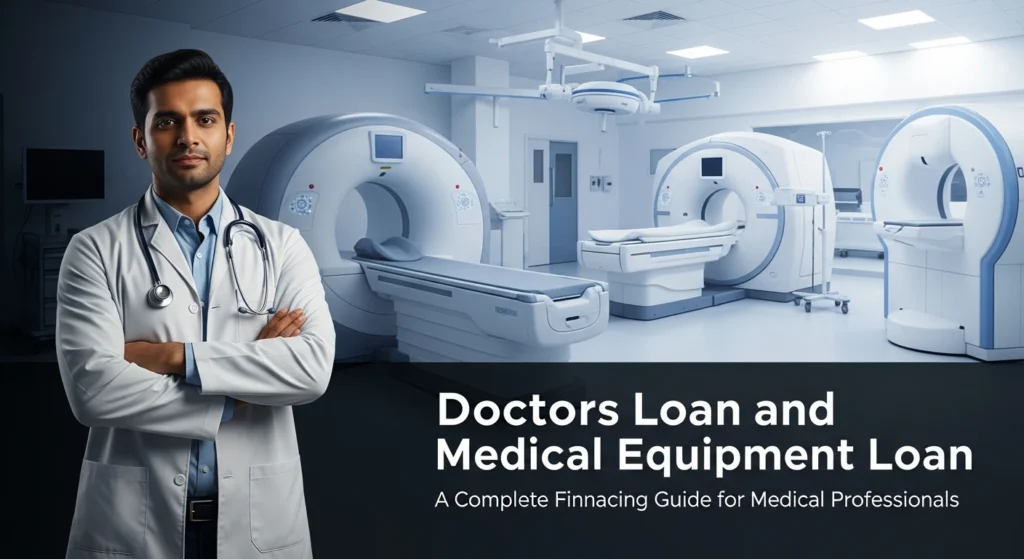
The healthcare industry in India is growing fast. Experts say that the healthcare market will be worth more than ₹30-31 lakh crore by 2027. This is because raising patients, medical technology is getting better and more private healthcare facilities are opening. This growth brings opportunities and comes with a bigger problem like capital investment.
Setting up a clinic, upgrading medical equipment, or expanding a hospital requires substantial financial investment. This is where doctors loan, medical equipment loan, and other forms of financing for medical professionals play a crucial role. Specialized financing solutions are essential in the medical profession, as they address irregular income cycles, expensive medical equipment, and growth returns.
Today, banks and NBFCs offer tailored healthcare business loans and loans for doctors in India, making it easier for medical professionals to focus on patient care without financial stress.
A doctor loan is a customized financial product designed exclusively for medical professionals such as MBBS doctors, MD, surgeons, dentists, and other specialists.
In simple terms, the doctor loan refers to a loan offered at preferential terms considering the stable income and low credit risk associated with doctors.
These features make loan for doctors a preferred financing option for medical professionals.
There are few types of doctor loans available, depending on the purpose of funding.
Created for working capital, staff salaries, operational expenses, or marketing. This falls under business loan for medical professionals.
Best for new practitioners planning to open a clinic. It covers interiors, medical furniture, and medical equipment.
For running hospitals or nursing homes looking to expand infrastructure, add beds, or open new branches.
Doctor’s personal loan offers higher loan amounts, lower interest rates, quick approval, flexible tenure, minimal documentation, and unrestricted usage, specially designed for medical professionals’ personal and professional needs.
A medical equipment loan is an advanced financing option for buying or upgrading healthcare equipment. Given that modern medical machinery can cost from a few lakhs to crores, loan for medical equipment becomes essential.
In simple terms, It helps doctors, clinics, and hospitals acquire advanced technology without paying the full cost upfront.
These loans come under healthcare equipment financing or medical machinery loans and are often structured based on the lifetime of the equipment.
Medical equipment loans cover a wide range of Healthcare Machines, making them extremely versatile.
Diagnostic & Imaging
Therapeutic & Treatment
Life Support & Critical Care
Surgical & Interventional
According to healthcare financing data, over 65% of private diagnostic centers in India depend on medical equipment loans to upgrade technology.
| Feature | Doctors Loan | Medical Equipment Loan |
|---|---|---|
| Purpose | Personal or business needs | Purchase of medical equipment |
| Security | Often unsecured | Equipment may act as collateral |
| Loan Amount | Medium to high | High value |
| Tax Benefits | Limited | Depreciation benefits |
| Best For | Flexibility | Asset based financing |
These loan eligibility for doctors criteria are generally more relaxed than standard MSME loans.
Having documents ready speeds up approval significantly.
Flexible loan EMI for doctors helps manage cash flow efficiently.
These healthcare financing benefits directly support long term practice sustainability.
Most lenders today offer an online medical loan application, significantly reducing paperwork and approval timelines. With experienced financial facilitators like KFIS Loan Service Provider, doctors and healthcare entrepreneurs can often receive approvals in as little as 48 to 72 hours, provided eligibility criteria and documentation are in place.
Avoiding these doctor loan mistakes ensures financial stability.
These steps help achieve fast doctor loan approval and quick medical equipment loan.
Understanding tax benefits on medical equipment loans can significantly reduce financial burden.
With rising healthcare demand and increasing competition, access to the right financing is no longer a choice, it’s essential. Whether it’s a doctor loan or a medical equipment loan, choosing the right financial solution empowers medical professionals to grow sustainably while delivering better patient outcomes.
Yes. Most lenders align the repayment tenure with the usable life of the equipment, ensuring affordability.
This structure minimizes financial strain while maximizing operational efficiency.
Yes. Many lenders offer loan top ups or refinancing options once repayment history is established. Refinancing can help,
This flexibility is especially useful for growing clinics and hospitals.
Medical equipment loans offer dual tax benefits,
These advantages make equipment financing a strategic financial decision rather than just a funding option.
Yes, new practitioners or first time borrowers may be asked to add a co applicant to strengthen eligibility. Established doctors with consistent income usually qualify independently.
Absolutely. Industry reports suggest that over 60% of private healthcare providers in India plan to invest in technology upgrades within the next five years. In this environment, doctor loans and medical equipment loans are no longer optional, they are strategic growth tools.
Digital underwriting has transformed healthcare financing. Online applications, AI based credit checks, and e document verification have reduced approval times by over 60% compared to traditional processes. This shift enables medical professionals to access funds without disrupting patient care.
Medical equipment loans are structured so that EMIs align with the revenue generated by the equipment itself. For example, diagnostic centers often recover EMI costs through patient billing within the first few months. Industry data shows that ROI on diagnostic equipment typically begins within 12-18 months.
It depends on the funding requirement,
From a financial standpoint, equipment loans are more tax efficient, while doctor loans offer greater flexibility.
Yes, new doctors can apply, especially for clinic setup or equipment loans. However, loan approval depends on factors such as qualifications, location, projected income, and co applicant strength.
With digital processes and specialized service providers, loan approvals have become much faster. Most online medical loan applications are processed within 48 to 72 hours, provided documentation and eligibility criteria are met. Faster approvals help medical professionals avoid delays in patient services.
Yes, many doctor loans are unsecured, meaning no collateral is required. However, the loan amount, interest rate, and tenure depend on income, credit profile, and years of practice. Equipment loans, on the other hand, may use the equipment itself as collateral.
Doctors holding a valid medical degree and registration with the Medical Council of India or State Medical Council are eligible.
Typically, lenders require 2-3 years of practice experience and a stable income record.
Doctor loan interest rates are generally lower than standard business loans, as medical professionals are considered low risk borrowers. Doctor loan interest rates typically range between 9% to 14% per annum,which is lower when compared to other industries depending on factors such as years of practice, income stability, and credit profile.
Medical equipment loan interest rates vary based on the type of equipment, loan tenure, and lender. Rates usually range from 10% to 16% per annum, with high value diagnostic equipment often attracting more competitive pricing due to strong revenue potential.
Yes. Doctors can hold,
As long as income supports EMI obligations, lenders allow parallel financing, enabling faster practice growth.
Yes, many lenders finance for imported equipment, provided it meets regulatory and valuation standards. This allows clinics to adopt advanced technology at a lower cost while still benefiting from structured financing.
The information provided on this blog is for general informational and educational purposes only and is not intended as financial, investment, or legal advice. While we strive to ensure the accuracy and reliability of the information shared, we make no guarantees of completeness, accuracy, or timeliness. You should not rely solely on this information when making financial decisions. Always consult with a qualified financial advisor or professional before making any financial or investment decisions. The views expressed are personal opinions and do not represent any official stance of financial institutions or partners. Use of this site and its content is at your own risk.

Automated page speed optimizations for fast site performance