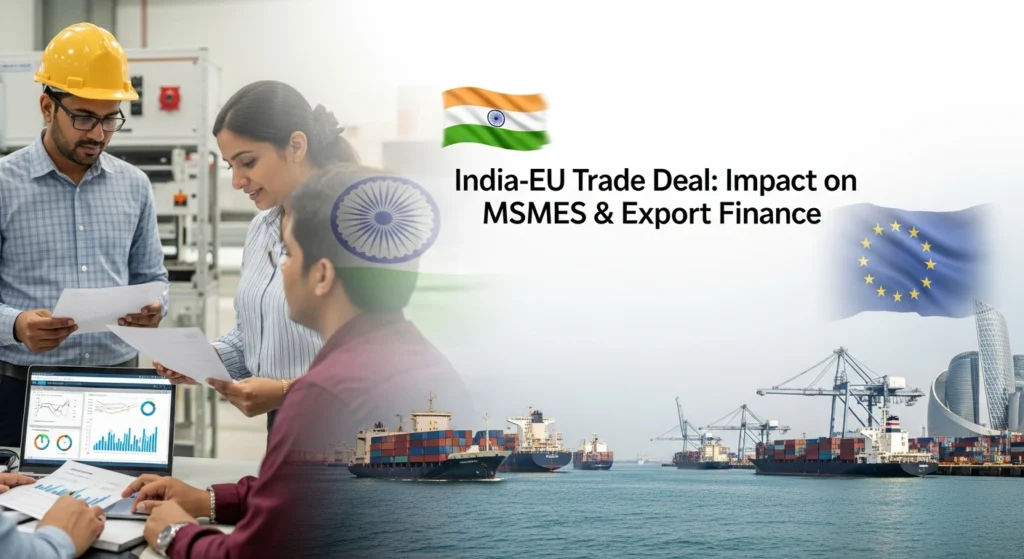
India’s historic Free Trade Agreement (FTA) with the European Union (EU), often called the “mother of all deals,” represents a structural shift in global commerce especially for Micro, Small, and Medium Enterprises (MSMEs) and the ecosystem of export finance that supports them. This long awaited pact unlocks preferential market access to one of the world’s richest consumer blocs, opening opportunities that could reshape India’s export landscape for decades to come.
In this article, we’ll explore what this landmark deal means for Indian MSMEs, how export financing will help them capitalize on new opportunities, and why strategic loan services like KFIS are becoming essential tools for growth.
After nearly two decades of negotiations, India and the EU finalized their Free Trade Agreement (FTA) in early 2026. Under the deal
For MSMEs which make up a significant portion of India’s export base such preferential access can be transformative. By reducing trade costs and simplifying market entry, the FTA removes barriers that previously hindered smaller players from competing on equal terms with global rivals.
MSMEs are the engine of India’s economy, employing millions and driving innovation across sectors. The FTA with the EU presents a once in a generation opportunity that can benefit MSMEs across traditional and emerging industries.
1. Dramatically Improved Market Access
Tariff elimination on key exports including textiles, leather goods, gems and jewellery, engineering products, and agri products means Indian MSMEs can now price their products more competitively in EU markets.
For example:
This reduction lifts pricing pressures and can help MSMEs scale exports faster.
Before this deal, countries like Bangladesh and Vietnam leveraged preferential EU access to grow their exports of textiles and apparel rapidly. Indian MSMEs were often disadvantaged due to tariff differentials. With the new FTA, Indian exporters can compete on similar or even stronger terms, capturing market share from established regional players.
Access isn’t just about tariffs. The FTA also encourages integration into global value chains allowing MSMEs to become reliable suppliers for larger firms and multinational supply networks. This can create more stable contract flows and deeper export relationships than merely winning seasonal orders.
While merchandise exports get much of the attention, services particularly IT, logistics, consultancy, and finance will benefit from smoother cross border operations. MSMEs operating service led models can tap into expanded opportunities in a booming EU demand environment.
While the FTA unlocks opportunity, it also raises practical questions like How will MSMEs finance scaling production, manage regulatory compliance, and navigate international payment cycles? This is where export finance becomes indispensable.
Exporting to Europe often involves,
For MSMEs operating on thin margins and limited capital, access to tailored export finance solutions can make the difference between successful scaling and stagnation.
Institutional support through strategic financing is essential for MSMEs to seize the opportunities from this trade pact. This is where financial service providers like KFIS come into play
KFIS (Khannan Finance & Investment Service) is a trusted loan distributor based in Chennai, serving businesses with financial solutions tailored to their operational needs. Through partnerships with multiple banks and NBFCs, KFIS helps MSMEs to access working capital, equipment finance and export oriented funding.
With over 20+ years of experience and a broad portfolio that includes MSME loans, working capital finance and export finance solutions, KFIS assists businesses in navigating liquidity challenges so they can deliver on international contracts without cash flow stress.
Scaling exports to the EU may mean producing large quantities before receiving payment. Working capital loans, offered through intermediaries like KFIS, provide short term finance service that bridges this gap allowing MSMEs to fulfill larger orders without tying up funds in inventory or production.
Smooth export operations depend on efficient supply chain management. KFIS also assists with supply chain and logistics finance, enabling MSMEs to support freight, warehousing and distribution costs a critical advantage in international trade.
With EU markets demanding high standards of quality, traceability and sustainability, many MSMEs need to upgrade equipment or obtain certifications to meet compliance. Targeted loans from service providers like KFIS help fund these critical upgrades, ensuring MSMEs can compete and qualify for premium EU contracts
The path forward isn’t without challenges for MSMEs,
EU markets have strict regulatory standards. Investing in compliance from quality certification to sustainability documentation can be costly. Export finance solutions provide the capital to meet these requirements without straining operational cash flows.
Working with international buyers often involves extended credit terms. Without adequate financing, MSMEs can face liquidity crunches. Bridging loans and invoice finance options help smooth cash flow and reduce dependency on internal reserves.
Competing with established EU suppliers demands scale, reliability and robust supply chain planning. Finance solutions help MSMEs expand capacity and meet delivery commitments crucial for building long term contracts overseas.
India’s landmark trade deal with the EU is more than a diplomatic milestone it’s a strategic economic opportunity that empowers MSMEs to scale exports, integrate globally and build sustainable businesses in premium markets. Preferential tariff access, broader services cooperation and integration into European value chains signal a new era for Indian exporters.
However, unlocking that potential depends on strategic financing and operational support. MSMEs must pair market access with smart financial planning to meet production scaling costs, compliance requirements and working capital needs. This is where trusted partners like KFIS become crucial offering tailored loan services and export finance solutions that help businesses translate opportunity into growth.
For India’s MSMEs, the future is beyond borders and with the right financial backing and strategy, the EU market could be the next growth frontier.
India’s historic free trade agreement with the EU aims to lower tariffs, increase market access, and boost economic cooperation. To increase bilateral trade, it concentrates on products, services, investment, and regulatory positioning.
By lowering trade barriers, facilitating easier access to EU markets, and improving regulatory clarity, the trade agreement creates new export opportunities for MSMEs. MSMEs can grow globally while taking advantage of favorable trade policies and rising demand.
An MSME loan agency helps Indian businesses trade with the EU by providing export finance, working capital, support for EU compliance costs, access to trade finance tools like letters of credit, and guidance on government export schemes making international trade smoother and less risky.
Indeed, increased investor confidence and trade flows could make it easier for MSMEs to get financing. Banks and NBFCs are likely to introduce specialized export focused financial products to support businesses entering EU markets.
MSMEs can manage cash flow, lower payment risks, and complete big international orders with the aid of export finance. Access to prompt export financing will be essential for MSMEs to successfully compete in European markets under the terms of the India-EU trade agreement.
The information provided on this blog is for general informational and educational purposes only and is not intended as financial, investment, or legal advice. While we strive to ensure the accuracy and reliability of the information shared, we make no guarantees of completeness, accuracy, or timeliness. You should not rely solely on this information when making financial decisions. Always consult with a qualified financial advisor or professional before making any financial or investment decisions. The views expressed are personal opinions and do not represent any official stance of financial institutions or partners. Use of this site and its content is at your own risk.