Access to the right capital at the right time can make or break a growing business. For Small and Medium Enterprises (SMEs), relying on a single loan product is often not enough to manage daily operations, expansion plans, and trade requirements simultaneously. This is where structured SME financing solutions come into play.
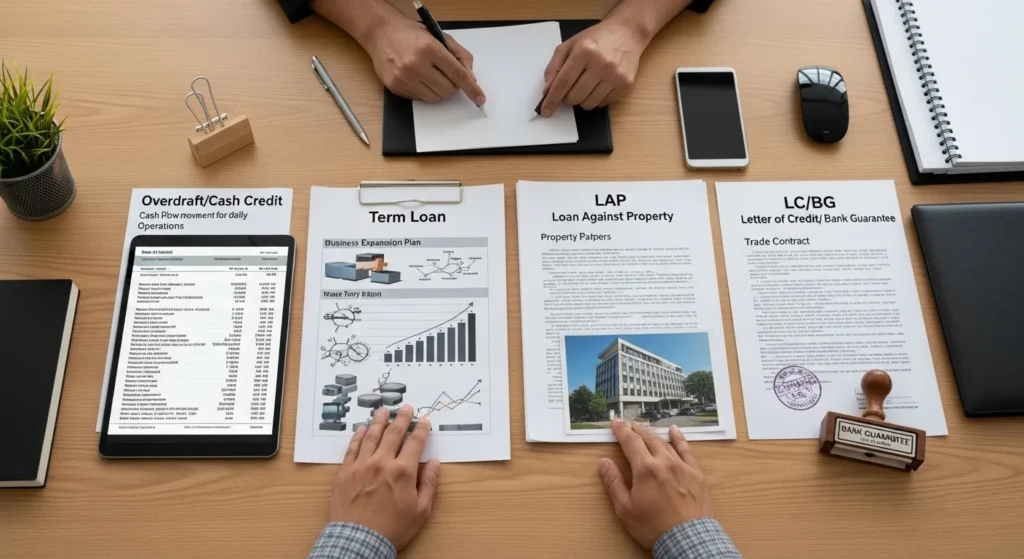
Instead of choosing between options, many successful businesses combine OD/CC, term loan, LAP, and LC/BG facilities to build a balanced and cost effective funding structure. Let’s break down how this works and why it’s becoming one of the best SME loan options today.
SMEs and MSMEs have unique financial needs. Unlike large corporates, they must carefully manage cash flows while scaling operations. Banks and NBFCs now offer a wide range of SME loans and MSME loans, designed to support both short term working capital and long term growth.
However, using a single facility for all needs often leads to,
A corporate lending structure that combines multiple loan products helps solve these challenges efficiently.
n OD/CC loan Overdraft (OD) or Cash Credit (CC) is a short term credit facility primarily used for working capital management. It allows businesses to withdraw funds beyond their account balance up to a sanctioned limit, with interest charged only on the utilized amount.
SMEs typically use OD/CC facilities for,
OD/CC loans are flexible and convenient, making them ideal for short term financial requirements. However, they are not meant for long term investments or capital expenditure.
Term loans are structured for planned, long term investments. They come with fixed repayment schedules and predictable EMIs, making them suitable for asset creation.
When combined with an OD/CC, term loans help SMEs avoid using expensive working capital funds for long term purposes.
A Loan Against Property (LAP) is a popular collateral based business loan that allows SMEs to unlock the value of owned property. Since the loan is secured, interest rates are typically lower compared to unsecured loans.
Growing SMEs, LAP acts as a bridge between affordability and scale, without diluting ownership.
LC, BG financing for businesses plays a crucial role in trade and contractual dealings.
These non fund based facilities reduce upfront cash blockage while strengthening credibility with vendors and clients.
When used together, these products form a powerful and flexible funding ecosystem,
This OD/CC, term loan, LAP, LC, BG structure ensures that each financial need is met with the most cost effective product, rather than overloading a single loan.
Understanding the difference helps SMEs make better decisions,
The right mix depends on business size, cash flow stability, and growth plans. A well structured approach improves liquidity without increasing financial stress.
Using multiple loan products together offers several advantages,
Banks increasingly prefer SMEs that adopt structured borrowing, as it reflects financial discipline and risk awareness.
Even the best financing structure can fail if mismanaged.
A professional review of loan structuring can prevent costly errors.
For modern SMEs and MSMEs, growth is no longer about choosing one loan over another, it’s about using the right combination. A thoughtfully designed SME financing solution using OD/CC, term loans, LAP, and LC/BG enables businesses to grow sustainably while maintaining liquidity and control.
When capital works in alignment with business needs, SMEs can focus on what truly matters, scaling operations, serving customers and building future value.
The eligibility for an MSME loan for women typically includes being a woman entrepreneur who owns or manages a registered MSME. The business should meet MSME classification criteria based on turnover and investment limits, have a valid business registration, and demonstrate stable operations. Lenders also assess credit history, cash flow strength and repayment capacity. Some government backed and bank schemes may offer relaxed eligibility norms, lower interest rates or reduced collateral requirements to support women led MSMEs.
An OD/CC (Overdraft) loan allows SMEs to operate funds beyond their account balance up to a sanctioned limit, helping manage working capital needs while paying interest only on the amount used.
4. What is the difference between an OD/CC and a term loan?
An OD/CC loan is used for short and long term working capital with flexible operation, while a term loan is a fixed amount loan repaid over a set tenure, ideal for long term business investments.
5. How do LC and BG work in business financing?
LC (Letter of Credit) ensures supplier payment, while BG (Bank Guarantee) assures contractual obligations. Both improve business credibility, reduce risk and support smooth trade and project execution.
6. Can SMEs take multiple loans at once?
Normally, it is not advised for SMEs to take multiple loans simultaneously, unless cash flows are stable and repayment capacity is strong. However, banks may structure multiple facilities when necessary to meet specific business needs and manage liquidity efficiently.
7. Is a loan against property good for business?
A loan against property is beneficial for businesses needing large, long term funds at lower interest rates, as it uses owned property as collateral while preserving cash flow flexibility.
SMEs can use multiple loans by combining overdraft for working capital, term loans for business expansion, and LAP for long term funding, creating a structured loan mix that improves cash flow and reduces financing needs.
9. How can SMEs combine OD/CC and term loan effectively?
SMEs can use OD/CC for daily operational expenses and a term loan for fixed investments, ensuring short term liquidity while spreading long term costs through structured monthly repayments.
10. Can you give an example of SME loan structuring?
SMEs usually adopt a mix of financing where equipment or plant purchases are funded through term loans, day to day operational needs are met via OD/CC facilities and long term capital requirements are covered through LAP, helping balance costs, liquidity and financial stability.
11. How can SMEs optimize working capital financing?
SMEs can optimize working capital financing by limiting OD/CC usage, converting long term OD/CC support into term loans and aligning loan repayments with business cash flow cycles.
12. What is the difference between OD/CC, term loan, and LAP for SMEs?
OD/CC is used for short term working capital, term loans support business growth, and LAP provides long term funding against property. Using them together helps SMEs balance liquidity, growth, and borrowing costs.
SMEs can improve eligibility for higher loan limits by maintaining strong financial records, consistent revenue growth, and healthy cash flow management. Timely repayment of existing SME loans, a good credit score, and lower debt levels increase lender confidence. Improving business transparency, filing regular tax returns and offering adequate collateral also help banks and NBFCs approve higher borrowing limits.
The information provided on this blog is for general informational and educational purposes only and is not intended as financial, investment, or legal advice. While we strive to ensure the accuracy and reliability of the information shared, we make no guarantees of completeness, accuracy, or timeliness. You should not rely solely on this information when making financial decisions. Always consult with a qualified financial advisor or professional before making any financial or investment decisions. The views expressed are personal opinions and do not represent any official stance of financial institutions or partners. Use of this site and its content is at your own risk.

Automated page speed optimizations for fast site performance